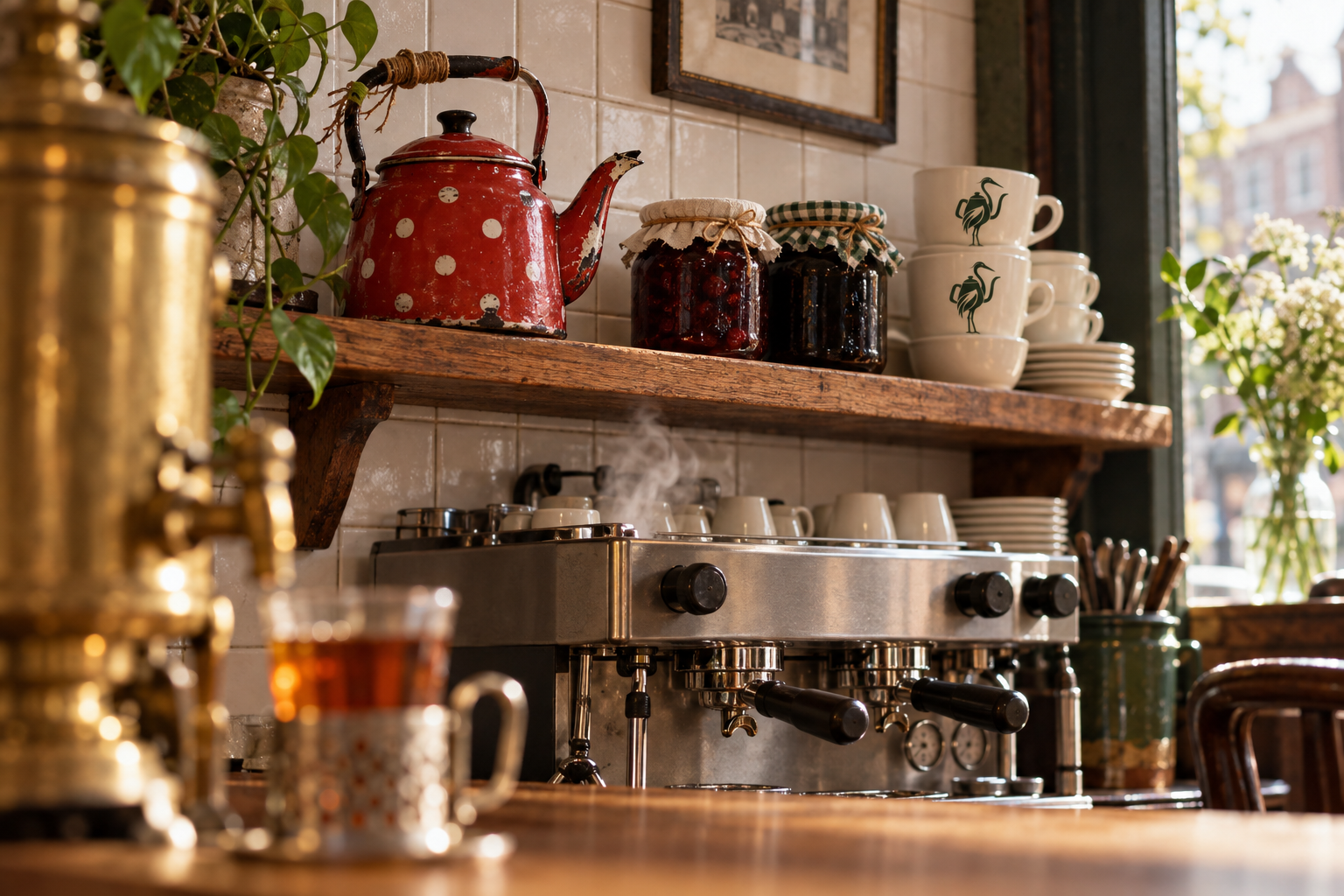
It sits on the shelf above the espresso machine, red enamel with white spots, a chip on the spout and a handle wrapped in old string. It belonged to my grandmother, Halina, and it is the kettle in our name.
A kettle on for every visitor
Babulya Halina lived in a village outside Pinsk, in the marshes of southern Belarus. Her house had a wood stove, a well in the yard and a bench by the door where the neighbours sat in the evenings.
The kettle lived on the stove. Whoever came through the door, the postman, a cousin, me at eight years old with mud to the knees, she filled it before she said hello. By the time your boots were off, the water was nearly boiling.
The jam came up from the cellar in a jar with a cloth over it: cherry in summer, blackcurrant by winter. Nobody left her kitchen in under an hour, and nobody left hungry. My grandfather said the kettle had boiled more water than the Pina river carried past Pinsk.
In spring and autumn the cranes went over the village, hundreds at a time, calling. She would stop with the kettle in her hand and wait until they had passed.
Tea before coffee
In a Belarusian kitchen you are offered tea first. Black, strong, in a glass, with a spoon of cherry jam on a saucer beside it and something on a plate you are expected to eat. Coffee came later in my life, in Minsk, from a colleague with a hand grinder.
I think of the café the same way. Before anything else, someone should notice you have come in and put something warm in front of you.
That is why the machine is the first thing Ade switches on at 7:00, so there is hot water before there is anyone to serve.
How it came to Amsterdam
Halina died in 2019. My mother gave me the kettle that summer, because I was the one who used to sit by the stove and watch it. When I moved to Amsterdam in January 2021, it travelled in my suitcase, wrapped in a jumper, between a laptop and a bag of dried mushrooms.
For three years it sat on a shelf, first in my flat and then in ours. When we opened, Inés said it should go where everyone could see it. She was right. It is the first thing new people ask about, and the question usually turns into a story about their own grandmother.
She filled the kettle before she said hello.
On Sundays we now pour loose-leaf tea from a samovar-style urn, black and strong, with jam on the side. Come and have a glass. Halina would have approved of the urn, and she would have told us to fill it sooner.
Maksim, from the roaster
5 comments